
The Enterprise Archive That Scales Without Breaking Compliance
Move cold data from operational databases into a governed, queryable data lake. Maintain compliance, enforce retention policies, and cut storage costs by 80%.
Moving rows where order_date < now() - 2y
842M
Rows archived
3.4 TB
Storage freed
12
Legal holds kept
-- query archived data with standard SQL
SELECT customer_id, SUM(total)
FROM archive.orders
WHERE order_date < '2022-01-01'
GROUP BY 1;
1,284 rows · 2.1s · Athena
PII columns masked for role: analyst
Enterprise Databases Are Drowning in Cold Data
80% of enterprise data is cold — rarely accessed but stored in expensive production databases for compliance. This drives up costs, degrades performance, and creates compliance risk.
Spiraling Costs
Production database storage grows 30-40% annually. Most of it is data that's never queried.
Compliance Burden
Regulations mandate data retention for 7+ years. Managing this in production systems is unsustainable.
Performance Degradation
Bloated databases slow down applications, backups, and disaster recovery processes.
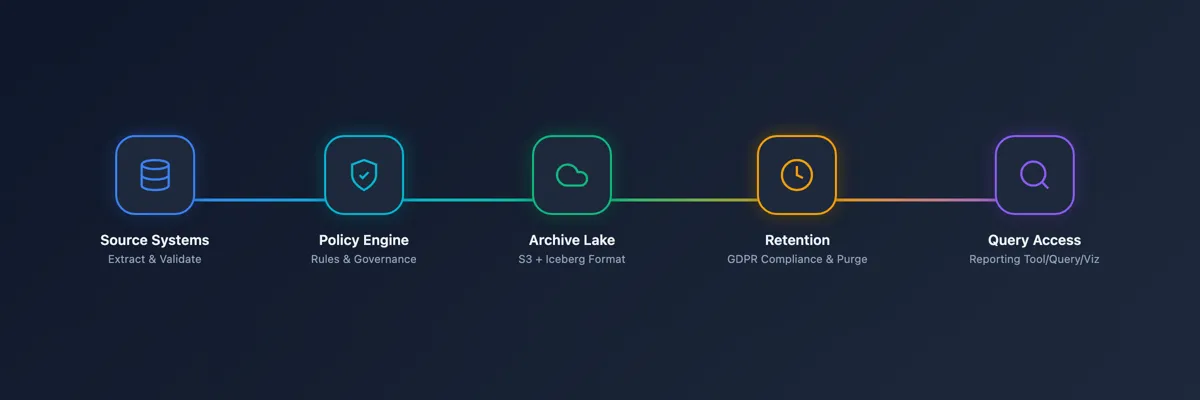
A Modern Archive Pipeline
ArchiveHouse moves data through a governed pipeline — from source systems to a queryable, compliant archive.
What Is Cold Data Costing You?
Cold rows sit on your most expensive storage, copied to every replica and standby. See what moving them to an ArchiveHouse archive saves.
Estimate uses AWS list prices: $0.115/GB-month for RDS gp3 storage versus $0.023/GB-month for S3 Standard. Archived data is stored once, as compressed Parquet in Apache Iceberg, so real savings are usually higher. Backups and compute are not included.
Everything You Need to Archive at Scale
Purpose-built for enterprise data archiving with compliance, governance, and query access built in.
Policy-Driven Archiving
Define retention policies per data source, table, or regulation. Automatically classify and move cold data.
Cloud Data Lake Archive
Archive to S3 + Apache Iceberg format for cost-efficient, open-standard storage at any scale.
Privacy & Compliance
Support for data purge workflows with legal hold enforcement and regulatory retention policies.
Query Archived Data
Query archived data directly via SQL through Amazon Athena or QuickSight dashboards.
Automated Retention & Purge
Set time-based retention rules. Automatic purge with full audit trails and legal hold support.
Metadata Catalog
Centralized catalog of archived datasets with schema capture and discovery capabilities.
Dynamic Data Masking
Automatically detect and mask PII like SSN, emails, and phone numbers. Role-based policies reveal data only to authorized users.
Policy-as-Code
Define governance policies in version-controlled YAML files. Review changes in PRs and deploy through your existing CI/CD pipeline.
Role-Based Access Control
Fine-grained access to archived data. Column-level permissions, row filtering, and cell-level masking per user role.
Why Enterprise Teams Choose ArchiveHouse
Reduce database costs by up to 80%
Enforce retention policies with legal holds
Query archived data on demand
Automated purge with audit trails
Mask PII with role-based controls
Version-controlled policy changes
Built for Real Enterprise Scenarios
Database Archival
Move historical records out of production databases to reduce cost and improve performance.
Explore Database ArchivalRegulatory Compliance
Meet retention requirements with configurable policies and legal hold enforcement.
Explore Regulatory ComplianceData Purge
Execute compliant data purge workflows across archived datasets with full audit trails.
Explore Data PurgeApp Lifecycle
Archive application data to open formats while preserving query access.
Explore App LifecyclePII Protection
Automatically detect and mask sensitive data. Grant role-based access with full audit trails.
Explore PII ProtectionHow ArchiveHouse Compares
Legacy archiving is limited to on-prem sources with EOL risks. S3 Lifecycle only supports age/access-based object rules — not business attributes or GDPR-compliant row-level operations.
| Feature | LegacyArchive | S3 Lifecycle / Intelligent Tiering | ArchiveHouse |
|---|---|---|---|
| Cloud Source Connectivity | — | ||
| On-Prem Source Connectivity | — | ||
| Active Vendor Support | — | ||
| Attribute-Based Policies | — | — | |
| Row-Level Retention & Purge | — | — | |
| GDPR Compliant Deletion | — | — | |
| SQL Query on Archives | — | ||
| Legal Hold with Audit Trail | — | — | |
| Open Format (Iceberg/Parquet) | — | — | |
| Age/Access-Based Rules | |||
| Dynamic PII Masking | — | — | |
| Policy-as-Code (GitOps) | — | — | |
| Role-Based Column Access | — | — | |
| Row-Level Security | — | — |